Saturday, March 5, 2011

Coding Horror: Why Can't Programmers.. Program?

Taken From codinghorror.com

Feb 26, 2007

Why Can't Programmers.. Program?

I was incredulous when I read this observation from Reginald Braithwaite:

Like me, the author is having trouble with the fact that 199 out of 200 applicants for every programming job can't write code at all. I repeat: they can't write any code whatsoever.

The author he's referring to is Imran, who is evidently turning away lots of programmers who can't write a simple program:

After a fair bit of trial and error I've discovered that people who struggle to code don't just struggle on big problems, or even smallish problems (i.e. write a implementation of a linked list). They struggle with tiny problems.

So I set out to develop questions that can identify this kind of developer and came up with a class of questions I call "FizzBuzz Questions" named after a game children often play (or are made to play) in schools in the UK. An example of a Fizz-Buzz question is the following:

Write a program that prints the numbers from 1 to 100. But for multiples of three print "Fizz" instead of the number and for the multiples of five print "Buzz". For numbers which are multiples of both three and five print "FizzBuzz".

Most good programmers should be able to write out on paper a program which does this in a under a couple of minutes. Want to know something scary? The majority of comp sci graduates can't. I've also seen self-proclaimed senior programmers take more than 10-15 minutes to write a solution.

Dan Kegel had a similar experience hiring entry-level programmers:

A surprisingly large fraction of applicants, even those with masters' degrees and PhDs in computer science, fail during interviews when asked to carry out basic programming tasks. For example, I've personally interviewed graduates who can't answer "Write a loop that counts from 1 to 10" or "What's the number after F in hexadecimal?" Less trivially, I've interviewed many candidates who can't use recursion to solve a real problem. These are basic skills; anyone who lacks them probably hasn't done much programming.

Speaking on behalf of software engineers who have to interview prospective new hires, I can safely say that we're tired of talking to candidates who can't program their way out of a paper bag. If you can successfully write a loop that goes from 1 to 10 in every language on your resume, can do simple arithmetic without a calculator, and can use recursion to solve a real problem, you're already ahead of the pack!

Between Reginald, Dan, and Imran, I'm starting to get a little worried. I'm more than willing to cut freshly minted software developers slack at the beginning of their career. Everybody has to start somewhere. But I am disturbed and appalled that any so-called programmer would apply for a job without being able to write the simplest of programs. That's a slap in the face to anyone who writes software for a living.

The vast divide between those who can program and those who cannot program is well known. I assumed anyone applying for a job as a programmer had already crossed this chasm. Apparently this is not a reasonable assumption to make. Apparently, FizzBuzz style screening is required to keep interviewers from wasting their time interviewing programmers who can't program.

Lest you think the FizzBuzz test is too easy-- and it is blindingly, intentionally easy-- a commenter to Imran's post notes its efficacy:

I'd hate interviewers to dismiss [the FizzBuzz] test as being too easy - in my experience it is genuinely astonishing how many candidates are incapable of the simplest programming tasks.

Maybe it's foolish to begin interviewing a programmer without looking at their code first. At Vertigo, we require a code sample before we even proceed to the phone interview stage. And our on-site interview includes a small coding exercise. Nothing difficult, mind you, just a basic exercise to go through the motions of building a small application in an hour or so. Although there have been one or two notable flame-outs, for the most part, this strategy has worked well for us. It lets us focus on actual software engineering in the interview without resorting to tedious puzzle questions.

It's a shame you have to do so much pre-screening to have the luxury of interviewing programmers who can actually program. It'd be funny if it wasn't so damn depressing. I'm no fan of certification, but it does make me wonder if Steve McConnell was on to something with all his talk of creating a true profession of software engineering.

Due to high volume, comments for this entry are now closed.

Posted by Jeff Atwood

Thursday, March 3, 2011

Jobs Unveils Apple's iPad 2 - WSJ.com

Steve Jobs asserted Apple Inc.'s command over the hottest market in computing and demonstrated his flair as high-tech's most celebrated pitchman.

The Silicon Valley giant's chief executive, who took a medical leave of absence in January, was the surprise master of ceremonies as Apple unveiled a second version of its iPad tablet—a product that has created a multi-billion dollar business in less than a year and left rivals scrambling.

Wall Street Journal Personal Technology Columnist Walt Mossberg gives his first impressions of Apple's new iPad2 which was unveiled today by Steve Jobs.

Mr. Jobs, who strode onto a San Francisco stage Wednesday to a standing ovation, showed off the thinner, faster iPad 2 in a presentation full of swipes at competitors flooding into the market. The crush of tablets includes Motorola Mobility Holdings Inc.'s recently released Xoom and the forthcoming Playbook from BlackBerry maker Research In Motion Ltd.

Apple has a more than 90% market share and "our competitors are just flummoxed," Mr. Jobs said, adding that if 2010 was the "year of the iPad," he might call 2011 "the year of the copycats."

Simon Constable and Marcelo Prince discuss what Steve Jobs' surprise appearance at Apple's Wednesday event could signal. Plus: where will iPad 2 fit in the tablet market?

The iPad 2, which like its predecessors starts at $499, will ship in the U.S. on March 11 and in 26 more countries on March 25. It comes with front and rear cameras—addressing an omission in the initial model—and a new Apple-designed chip that Mr. Jobs said performs standard calculations twice as fast as its predecessor and offers a nine-fold boost in graphics performance.

Many of the changes were widely expected, and evolutionary. But analysts said Apple had reinforced its edge with the sheer volume of new features, its lead in applications created for the iPad and its lower price point than some rivals; Xoom, for example, starts at $799 without a cellular service plan, compared with $729 for a comparable iPad.

"Apple moved the goal posts before most of their competitors even take the field," said Noah Elkin, an analyst at research firm eMarketer.

Mr. Jobs stressed that the new iPad was part of a growing new "post-PC" category of devices, which also includes its iPhone. The company faced a slew of skeptics when it first introduced the iPad a year ago, yet it managed to sell 14.8 million of the devices globally as of the end of 2010, generating $9.5 billion in revenue.

The tablet accelerated the growth of a large ancillary business based on software and content sales; Mr. Jobs said Apple now has 200 million accounts with customers around the world, and said software developers have made more than $2 billion from sales through the company's App Store.

The iPad has become a major force in the publishing world, and a rival to Amazon.com Inc.'s Kindle. Apple said more than 2,500 book publishers have joined its iBookstore and more than 100 million e-books have been downloaded.

Introducing the iPad 2

Justin Sullivan/Getty Images

Apple CEO Steve Jobs on stage at the iPad 2 introduction.

Mr. Jobs disclosed that e-books published by Bertelsmann AG's Random House Inc., the country's largest consumer book publisher, are for the first time being sold directly via the iBookstore. Random House titles had been conspicuously absent because of a disagreement related to pricing.

Some magazine and newspaper makers have also flocked to the iPad, though Apple has triggered opposition with a recent policy that requires them to offer any subscriptions through apps as well as their own websites, which requires a revenue split with Apple.

Magazine publishers are hopeful that competitors spur Apple to relax such policies, but some on Wednesday acknowledged Apple's position looks even stronger after iPad 2.

"All I kept thinking as I watched the presentation today was that Apple just pulled a Secretariat," said John Loughlin, executive vice president and general manager of Hearst magazines, referring to the champion thoroughbred. "They just left their competitors 31 lengths behind."

Viewed from the front, the iPad 2 looks largely the same as its predecessor, aside from the addition of a small camera. It comes with a white as well as black front, and with and without 3G wireless service provided by either AT&T Inc. or Verizon Wireless in the U.S. Unlike some rival tablets, the new iPad cannot connect to high-speed 4G cellular networks.

Apple will also sell a new cover that snaps to the side of the device with magnets and comes with cloth on the inside that can help clear smudges off the glass screen.

The company also showed a new version of its mobile operating system and other internally developed software, including a version of its music recording program Garage Band.

Analysts, in particular, praised the iPad 2's design, which is thinner than the current iPhone and 15% lighter than the original iPad, shrinking from 1.5 pounds to 1.3 pounds. Those changes could make the iPad more portable and appealing as a reading device for books and periodicals.

What's under the hood of the iPad 2 could also be important, illustrating Apple's unusual role as both designer and user of chips. The new A5 chip in the iPad 2 adds a second calculating engine--an aid in doing multiple computing chores at once- plus a big increase in graphics circuitry that could inspire game developers.

"Games push the limits of devices as hard as any applications can," said Travis Boatman, a senior vice president for the EA Mobile division of Electronic Arts Inc. "Faster hardware is going to make it a better games experience."

It was the appearance of Mr. Jobs at the event that stirred the strongest reaction of the day. The Apple chief has struggled with health problems since having cancerous tumor removed from his pancreas in 2004, and in January handed day-to-day control of the company to Chief Operating Officer Tim Cook.

[0302jobs2] Associated Press

Apple CEO Steve Jobs speaks at an Apple event March 2.

Appearing in his standard black turtleneck and jeans, Mr. Jobs looked gaunt, as he has in recent years. But he was energetic, with no visible diminishment in the enthusiasm he has long shown when introducing new products.

Gene Munster, a Piper Jaffray analyst, called Mr. Jobs' appearance at the event "huge," saying investors have worried about the CEO's health, especially after the recent publication of paparazzi photos of a withered-looking Mr. Jobs.

"I think he sent a statement that he's really in charge and an active part of this," Mr. Munster said. "It was a big surprise."

Apple shares, which had been flat, moved higher after Mr. Jobs appeared on stage. The stock ended the 4 p.m. Nasdaq session up less than 1% at $352.12.

Mr. Jobs made no reference to his health issues Wednesday, focusing strictly on the iPad 2. "We've been working on this product for a while," Mr. Jobs said shortly after he took the stage, "and I just didn't want to miss today."

Wednesday, March 2, 2011

Convert YouTube to MP3, Get MP3 from YouTube video, FLV to MP3, extract audio from YouTube, YouTube MP3 - ListenToYouTube.com

MP3 From YouTube Flash Video

ListenToYouTube.com is the most convenient online application for converting YouTube flash video to MP3 audio. This service is fast, free, and requires no signup. All you need is a YouTube URL, and our software will transfer the video to our server, extract the MP3, and give you a link to download the audio file.

Extract Audio from FLV files without Quality Degradation | Inspired Geek

FLV or flash video is THE most commonly used format for streaming videos on many video sharing websites such as YouTube, MetaCafe, Google Video and many others. I have already discussed that how you can conveniently download multiple files from these online video sharing websites using Orbit downloader. But sometimes you don’t want the video part part of the FLV file and only the audio part(preferably in mp3 format). You may want this for a number of reasons but most probably to transfer favorite audio songs to your portable audio player such as IPod, Zune etc.

There are a number of software available both freeware and shareware that allows to extract the audio part of an FLV file but almost all of these re-encode the audio after extraction to the desired output format such as MP3. As a result the extracted MP3 file you will get may not have preserved the 100% quality of the original audio stream that was originally there in the FLV file. Also because re-encoding is involved in this process the conversion may take some time for FLV files with a longer play duration.

FLV Extract is a tiny utility that is a perfect solution for this situation. It allows to extract the embedded audio(mp3) part from the FLV file in the original as it is form. As a result you will not experience any loss in quality because of the re-encoding because no re-encoding is involved at all. As a bonus, extraction process will be lightning fast. All you have to do is to drag&drop the desired FLV file on the interface and the Audio, Video, and Timecodes will be extracted in the same folder.

It is a must have if you frequently need audio from your downloaded FLV files for some reason. You can get FLV Extract from here.

Nokia Strategy 2011 | Nokia Conversations - The official Nokia Blog

Nokia Strategy 2011 | Nokia Conversations - The official Nokia Blog

Nokia and Microsoft -> Replace Symbian with Windows Phone 7.... OMG!!!

Saturday, February 26, 2011

How to Make OpenCola: 10 steps - wikiHow


While
Pepsi and Coca-Cola (and others) closely guard their secrets to making cola beverages, several organizations have released their own recipes. Below is the recipe for homemade "OpenCola," an open-source cola beverage that invites makers to create and modify their recipe to achieve a better beverage. It is licensed under the GNU General Public License.

Ingredients

All ingredients listed are in metric units.
Flavoring
  • 3.50 mL orange oil
  • 1.00 mL lemon oil
  • 1.00 mL nutmeg oil
  • 1.25 ml cassia (cinnamon) oil
  • 0.25 mL coriander oil
  • 0.25 mL neroli oil (similar to petitgrain, bergamot, or bitter orange oil)
  • 2.75 mL lime oil
  • 0.25 mL lavender oil
  • 10.0 g food-grade, NOT ART-GRADE gum arabic (thickener)
  • 3.00 mL water
Concentrate
  • 5 mL flavoring
  • 17.5 mL 75% citric acid or phosphoric acid
  • 2.00 L water
  • 2.00 kg granulated white sugar
  • 2.5 mL caffeine (optional as it won't change taste of drink)
  • 30.0 mL caramel color

Steps


Flavoring

  1. Mix the oils together.
  2. Mix the oils together.
  3. Add gum arabic and mix completely.
  4. Add water and mix well. For this step, use a hand mixer or blender to thoroughly mix together.
  5. The flavoring can be made in advance and stored for use later. Place in a sealed glass jar and place in the refrigerator or keep at room temperature. When stored, the oils and water will separate. Just mix again before use. When used, the gum arabic will keep things together.

Concentrate

  1. Mix 5 mL of flavoring with the phosphoric or citric acid.
  2. Mix the water and sugar and, while mixing, add caffeine if desired.
    • Make sure that the caffeine is completely dissolved before moving on to the next step.
  3. Pour the acid and flavoring mixture slowly into the water/sugar mixture (adding acid to water reduces the risk of acid splashes compared to the other way around)
  4. Add caramel color and mix completely.

Soda

  1. 1
    Mix one part of concentrate with five parts water. In other words, however much you use of the concentrate, use five times as much of water.
  2. Carbonate the beverage. There are a few ways this can be accomplished:

Tips

  • It can be difficult to find all the different ingredients. They are not always available in supermarkets. Try looking at local specialty shops in their baking section.
  • Don't confuse this homemade recipe with the canned cola that's been distributed at trade shows and through other venues or outlets. While the recipe is the same, the process of canning soda is beyond the scope of this article.

Warnings

  • Caffeine can be toxic in high doses. Be careful not to add too much to your mixture, to be safe, keep the concentration below 100mg/cup.
  • Many of the oils needed for flavoring can irritate skin. Use caution when preparing. They can also dissolve the plastic lining of a refrigerator; store with caution, e.g. in a glass container.
  • Gum arabic is available in two forms, art grade, and food grade. Be sure to get food grade Gum arabic, or you could have a very unpleasant toxic reaction.
  • Phosphoric acid will burn if it comes into contact with you. If you do get acid on you, flush the affected area with water for at least 15 minutes and get medical attention.
  • Lavender oil can cause many dangerous side effects, so you may want to leave this out.

Thursday, February 24, 2011

Ethical Hacker Wannabe??? Take EC-Council Certification!!!

EC-Council carved the path for ethical hacking as a globally accepted practice in Information Security Assurance. The creation of the Certified Ethical Hacker in 2003 shook the core of the Information Security Community proving that policy and awareness simply weren't enough. Now, a globally accepted information security organization, EC-Council provides Completely Vendor Neutral tactical security programs. Our certified members earn top salaries by employing the most advanced capabilities. To beat a hacker, you must think like one, this is the premise of our flagship certification, the Certified Ethical Hacker, which teaches the tools and techniques of the worlds most notorious underground hackers.


Our global leading curriculum is refreshed at an alarming speed. To stay in tune with this rapid changing industry, EC-Council invests millions into R&D across hundreds of experts in each program, equipping global thought leaders and security practitioners with the tools and knowledge to defend what matters. Over 450 training centers in over 70 countries have seen what EC-Council security programs are capable of and proudly deliver our programs. Testing is available in over 3,000 locations around the globe. Organizations like the Air Force Information Operations Center, Naval Post Graduate School, McAfee University, Carnegie Melon all teach to EC-Council programs along with the global Authorized Training Channel.

EC-Council's cutting edge programs are defining the world of ethical hacking. Recognized by the US Department of Defense, CEH is a premier certification option for US Cyber Defenders. Recognized by the National Security Agency Committee on National Security Standards at every level, EC-Council programs cover everything from Novice Computer Security to techniques used in defending critical infrastructure and top secret government networks in the "Enclave.


The learning doesn't stop with our training. Certified candidates will be equipped with a plethora of tools through EC-Council's many industry contributions. Certified candidate's will posses the ability to apply acquired knowledge to secure real assets. Weekly and Monthly Security Seminars are held at no charge to our members providing continuing education from global thought leaders and best of breed organizations. EC-Council First look programs provide awareness and exposure to additional domains in security broadening your scope, We provide News Communities through our Hacker Journals Project, Code Red Center provides latest threats and alerts ensuring you are always up on current issues. EC-Council even has a private University, Licensed by the NM Department of Higher Education providing a Masters Program in Security Science taking your knowledge and certifications to a globally superior level in a field that requires nothing less to stay secure.

Learn what over 30,000 other security practitioners and leaders already have, join our base of Certified Members and reap the benefits. Secure your organization, grow your career, become a part of the most elite Ethical Hacking Community in the world.

PIKOM PC FAIR 2011

Visitor Information

Exhibitor Information


DATES, LOCATIONS & LAYOUT PLANS

25-27 February 2011
Melaka International Trade Centre (MITC), MELAKA [
Layout Plan]
Click here,
Shuttle Service Schedule New

4-6 March 2011
Level 1, Persada Johor International Convention Centre, JOHOR BAHRU [
Layout Plan]
Exhibition Hall 1, Sultan Ahmad Shah (SAS) Convention Centre, The Zenith Hotel, KUANTAN [
Layout Plan]
Dewan Jubli Intan, MUAR [
Layout Plan]

10-12 March 2011
Kompleks Balai Islam, KOTA BHARU [
Layout Plan]
Terengganu Trade Centre, KUALA TERENGGANU [
Layout Plan]

11-13 March 2011
LG Carpark Exhibition Hall, 1Borneo, KOTA KINABALU [
Layout Plan]
Dewan Tunku, KOMTAR, PENANG [
Layout Plan]

15-17 April 2011
KL Convention Centre, KUALA LUMPUR
[
Conference Hall 1-3] [Banquet Hall] [Ballroom][Exhibition Hall1 & 2] [Exhibition Hall 3] [Exhibition Hall 4 & 5]
Batu Pahat Mall, BATU PAHAT [
Layout Plan]
Village Mall, SUNGAI PETANI [
Layout Plan]
Permata Car Park, KUCHING [
Layout Plan]
Dewan Masyarakat, TAWAU [
Layout Plan]

22-24 April 2011
Dewan Masyarakt, SANDAKAN [
Layout Plan]
Miri Indoor Stadium, MIRI [
Layout Plan]
Sibu Trade & Exhibition Centre, SIBU [
Layout Plan]
Dewan Merdeka, SERI MANJUNG [
Layout Plan]

6-8 May 2011
Penang International Sports Arena (PISA), PENANG [
Layout Plan]

19-21 May 2011
Kelantan Trade Centre, KOTA BHARU [
Layout Plan]

20-22 May 2011
Stadium Indera Mulia, IPOH [
Layout Plan]

Tablet Wars: iPad 2 Vs. Android 3.0

Google (Nasdaq: GOOG) released its "Honeycomb" 3.0 Android software development kit (SDK) Wednesday just as Apple Inc. (Nasdaq: AAPL) hinted that its long-rumored iPad 2 launch event will happen next week.
Twitter Inc. is buzzing with talk about the March 2 Apple launch in San Francisco. Some commentators are wondering how the iPad 2's debut will overshadow the arrival of tablets using the Android 3.0 OS.
"Apple is holding a special event next week to announce that 300+ Android tablets will be DOA this year," quips BGR's Zach Epstein on his Twitter feed.
What they say
Specifically, PC World suggests that the Pad 2 will definitely divert attention from the launch of the Motorola Inc. (NYSE: MOT) Xoom Thursday. The Xoom is the first tablet to arrive using the tablet-specific version of the Android operating system. (See When Will Thunder Strike Verizon?)
Nobody exactly knows what the specs of the iPad 2 will be yet. That hasn't stopped Wired from putting together a wish list of features for the new version of the best-selling tablet.
But if Android developers are concerned by iPad 2, it isn't showing yet. The Android developers' blog has just unveiled a parcel of new material centered around the OS.

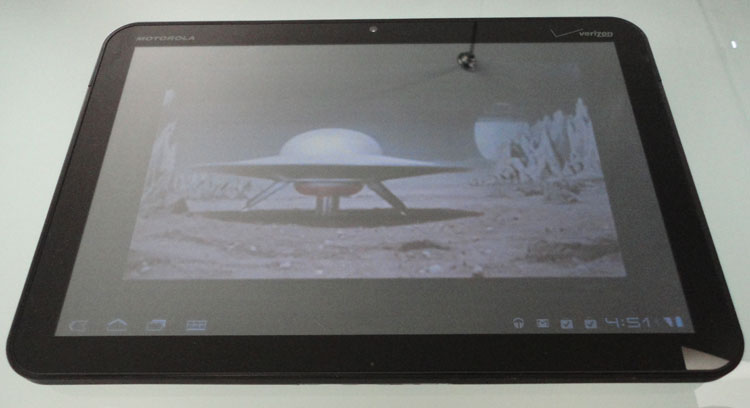
Motorola Xoom preview: Hands on first impressions

Motorola Xoom

Rob Enderle goes hands on with Motorola’s new Android Honeycomb tablet, discovering a solid but unremarkable iPad competitor that fails to wow.

The Motorola Xoom is the first product to market using Android Honeycomb. The Xoom is attractive, and the screen is gorgeous, but I’m increasingly convinced that the only way to beat the iPad is with something truly unique.

People just rave about the iPad, and I don’t think they will do that about the Xoom, mainly because Motorola left it unfinished from the get-go.

Xoom’s competance

Generally, folks have about five things they like to do with tablets. These include browsing the Web, enjoying media (books, music, movies), e-mail, taking notes, and playing games.

The Xoom has a good browser but unfortunately the one advantage it was expected to have, Flash support, won’t be available until June – what a dumb move. Internet speed is not better than the iPad out of the gate either because the other advantage, 4G wireless support, isn’t available yet at this time too. It too should be an upgrade you’ll get in June, or about the time the new 4G iPad is supposed to show up.

The Kindle application loaded and ran nicely on the Xoom although I still prefer my Kindle to either the iPad or Xoom if given the choice, and can hardly wait for the first tablet with a transflective display. Slacker, my favorite music streaming service, loaded flawlessly, and the sound out of the Xoom’s built-in speaker was much better than that of the iPad. The Netflix client isn’t supported on Android, so Xoom shares the inability to run it with all other Android devices.

Moving movies onto the device wasn’t particularly easy either. There is no iTunes-like desktop client, and while it seemed to work with Windows Media Player, the movies didn’t actually seem to move until I copied them manually. Then I had to scan the device to see where to put them. I used already transcoded (MPEG-4) movies, and then watched Army of Darkness as a test.

Motorola Xoom

The optional base, which came with the Xoom, has a nice set of speakers in it for a desktop experience and the clock application makes for an attractive desktop clock, but it plays ringtones for an alarm and you’d have to get another app to turn it into a full blown clock radio.

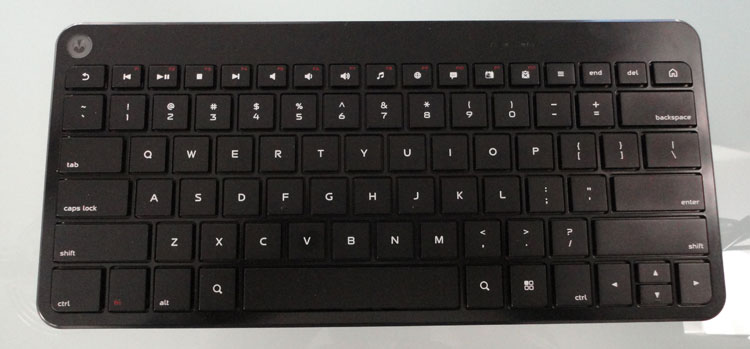
The Xoom supports Gmail out of the box, but you have to load a third-party application to do Exchange support. I’ve used a couple on other Android phones, and they are adequate. I’d prefer having this out of the box though. The best keyboards for the iPad typically come with a case for the device and allow you to prop the device up while using it in this mode. The Motorola keyboard doesn’t come with any way to hold the Xoom up, otherwise it worked fine and was easy to set up and type with.

I loaded Angry Birds and lost about an hour playing. Very addictive game.

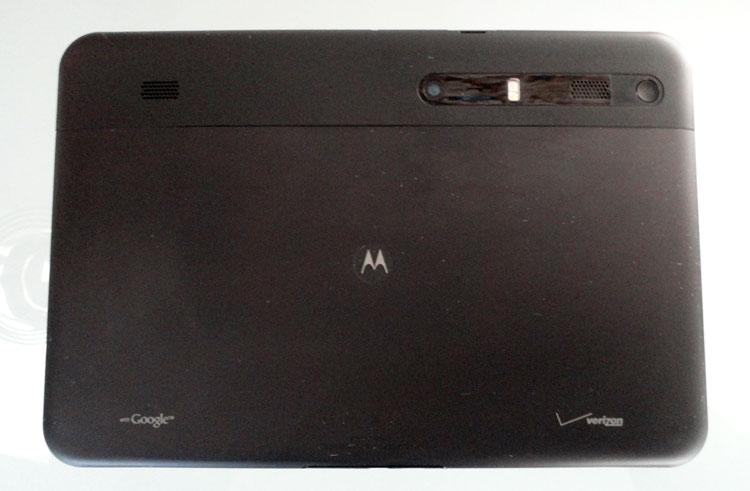
Finally, the camera on the Xoom is one of the best I’ve yet used on a mobile device with a nice dual-LED flash.

Where’s the magic?

Part of what makes the iPad wonderful is the out-of-box experience. It pretty much comes with all of the initial stuff you need, and you don’t have to read a manual to figure it out. The Xoom felt somewhat unfinished in comparison – particularly when it came to playing videos. It took me far longer than it should have to get the experience I wanted. Once I got the video playing, the sound and picture were better than the iPad, but many people wouldn’t have spent the time, and likely given up frustrated. With the iPad, you get the sense that the Apple folks actually used the device – what a novel thought righ? With the Xoom, it feels like that final step may have never actually occurred. This isn’t a hardware or software problem as the device could do what I wanted, except for Netflix. It’s a usability issue, and this is where Apple continues to shine.

More than that, when Apple brings out a product, it presents it in a way that makes it hard to not get excited about. Motorola presented the Xoom to me in a room of five PR people, many of which were doing e-mail on their phones and not really engaged with the Xoom in the first place. Not a single one, except the guy doing the demo, was actually using a Xoom. It gave the impression they were presenting something they wouldn’t actually use themselves and it really took the excitement out of the device.

Motorola Xoom

The accessory keyboard suggested you’d need a kickstand for the Xoom to make it work. The iPad has the same problem, but it also has third-party keyboards that come with stands and nicely integrate with the product. I felt that Motorola simply didn’t watch the iPad in use and instead is learning the hard way.

In the end, given the choice between an iPad and a Xoom I’d likely pick the iPad as something to give as a gift. For myself, I might pick Xoom, but would likely hold off until Flash support and LTE arrived. Against the iPad 2, I’d have a vastly tougher choice. If Motorola and Google improved the user experience and figured out how to get Netflix onto the device, I still might prefer it over the iPad 2, but it would be a tough call.

The magic is in the presentation

Tablets like the iPad and Xoom are far from cheap, generally costing close to $800 before any connectivity charges. People don’t want to become technicians in order to use them, and the Xoom has the feel of an incomplete offering. From the lack of Flash and LTE 4G support, to the difficulty in playing videos and the keyboard accessory without a kickstand, Motorola has a way to go. The Xoom has the bones of a great product but it needs to be fleshed out to be successful. That seems a shame because with a little more work, this probably would have been a truly great product. Apple products have a magic about them, and for anyone wishing to compete with Apple, baking in some polish in both the user experience and the presentation is a requirement that shouldn’t be overlooked.